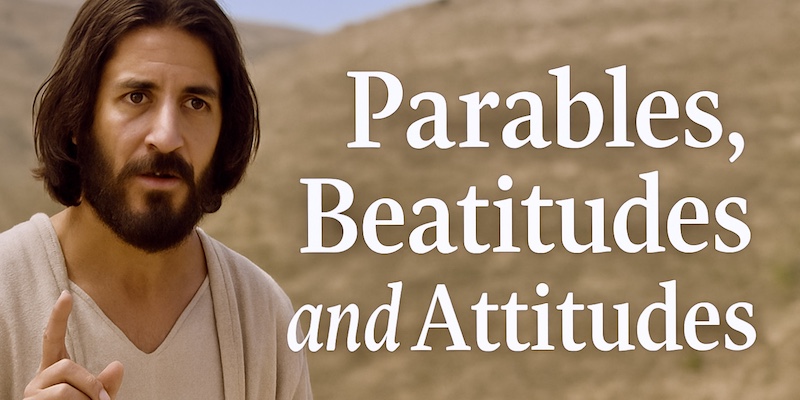
The Beatitudes & Attitudes
Matthew 5:3-12
January 3, 2026
The Beatitudes & Attitudes. Matthew 5:3-12.
1. Blessed are the poor in spirit, for theirs is the kingdom of God. . . Humility
2. Blessed are those that mourn, for they shall be comforted . . . Repentance
3. Blessed are the meek, for they shall inherit the earth . . . Gentleness
4.Blessed are those who hunger and thirst for righteousness, for they shall be filled . . . Obedience
5. Blessed are the merciful . . . Forgiveness
6. Blessed are the pure in heart . . . Integrity
7. Blessed are the peacemakers . . . Reconciliation
8. Blessed are those who are persecuted . . . Courage
1. Introduction – Overview
Beatitude #1 – The word “Blessed” in the greek is “Makarios”, which means happy, fortunate and blissful. The term “makarios” is referred to in scripture as a happiness that comes from a deep inward contentment that ones life is right with God based on the new life he has created within us. It’s a happiness that comes from an inward attitude of gratitude not a condition predicated on assumed outward comforts.
The word “Poor” comes from the Greek word, “Ptochos”, which means not just poor, but begging poor. In Mark 12:41-44, we see the Widow was poor, but she still had two pennies that she could give at the temple. In Luke 16:19-31, Lazarus the beggar was so poor, he didn’t have even two pennies to his name. That is “Ptochos” poor.
MacArthur: “This beatitude comes first because it is foundational; no one enters the kingdom without acknowledging spiritual poverty.”
Beatitude #2 – “The mourning about which Jesus is talking in the second beatitude . . . is speaking of godly sorrow, godly mourning that only those who sincerely desire to belong to Him or who already belong to Him can experience . . . Godly sorrow is linked to repentance, and repentance is linked to sin.” John MacArthur, pages 156-157.
“For the sorrow that is according to the will of God produces a repentance without regret, leading to salvation, but the sorrow of the world produces death. For behold what earnestness this very thing, this godly sorrow, has produced in you.” 2 Corinthians 7:10-11
Beatitude #3 – The word “Gentle” is from greek work “Praos”, which basically means mild or soft . . . The essential difference between being poor in spirit and being meek, or gentle, may be that poverty in sprit focuses on our sinfulness, whereas meekness focuses on God’s holiness. The basic attitude of humility underlies both virtues. When we look honestly at ourselves, we are made humble by seeing how sinful and unworthy we are; when we look at God, we are made humble by seeing how righteous and worthy He is.” John MacArthur Commentary on Matthew page 170.
“Meekness is not weakness. Instead, meekness is being an unashamed fully armed Man of God, trained and ready to engage in all forms of spiritual warfare, yet unquestionably submissive to God’s high command to live life with a gentle and quiet spirit . . . until called to do differently.” D. Mike Collins
“Because of Christ we give off a sweet scent rising to God,
which is recognized by those on the way of salvation – an aroma redolent with life.”
2 Corinthians 2:15
2. Beatitude #4 – Hunger & Thirst for Righteousness
Matthew 5:6, “Blessed are those who hunger and thirst for righteousness, for they shall be filled.”
“Jesus declares that the deepest desire of every person ought to be to hunger and thirst for righteousness. That is the Spirit-prompted desire that will lead a person to salvation and keep him strong and faithful once he is in the kingdom. It is also the only ambition that, when fulfilled, brings enduring happiness.” Joh MacArthur Matthew Commentary page 178.
What are you hungry and thirsty for? As men we chase a lot of things in this lifetime. What have you chased and how as it satisfied the deepest longing of your “soul”?
In 2020 we went through the book, “Living Life Backwards” by David Gibson. We saw how King Solomon chased many things and what did we learn?
Wisdom & Knowledge. Even great wisdom becomes forgotten, and there’s nothing truly new under the sun (Ecclesiastes 1).
Wine, Women & Song. Solomon indulged in wine, hundreds of wives and diversions of all kinds, but found the joy temporary and ultimately empty (Ecclesiastes 2).
Buildings & Possessions. All his toil and building projects ended up meaningless to him, as he would leave it all behind. (Ecclesiastes 2).
“Chasing the wind” (or hebel, meaning vapor/vanity) signifies that these pursuits are like trying to grasp something intangible and fleeting.
The book’s final verdict (Ecclesiastes 12:13-14) is clear: “Fear God and keep His commandments, for this is the whole duty of man. For God will bring every deed into judgment, every hidden thing, whether good or evil”.
“The whole of the spiritual life begins with a sense of emptiness.”
Charles H. Spurgeon
3. What does Hunger & Thirst even Mean?
The words hunger and thirst will most likely have very little meaning for us since many of us have never gone without a meal or two in our lives. The words here are not just a casual hunger and thirst where I need a snack and a soda. The words used here are ones of intense pain and desire for food and drink. The words used here are more along the lines of one who is famished and ravenous for food and delirious for water.
When have you been so famished that you felt ravenous? Have you ever been without water to the extent that you couldn’t think about anything else? How did it feel?
David said it this way, “O God, You are my God, I shall seek Thee earnestly; my soul thirsts for Thee, my flesh yearns for Thee, in a dry and weary land where there is no water.” Psalm 63:1. And again, “”As the deer pants for streams of water, so my soul pants for you, my God,” Psalm 42:1.
When has your “soul” thirsted and yearned for something on the scale of being famished? What did it feel like?
“John Darby Wrote, “To be hungry is not enough; I must be really starving to know what is in God’s heart towards me. When the prodigal son was hungry, he went to feed on the husks, but when he was starving, he turned to the Father”. That is the hunger of which the fourth beatitude speaks, the hunger for righteousness that only the Father can satisfy.” John MacArthur Matthew commentary page 182.
How starving are you for the righteousness of God? Scale of 1 to 10, where are you now? Where might you want to be in 2026?
How do you know if you are “famished” for the righteousness of God? 1. You seek for it without being told. 2. It’s there when you awake and go to sleep. 3. The search for it never ceases to command your time and attention. 4. Sin not only loses it luster, it is like vomit to you. 5. To the extent sin repulses you, righteousness consumes you.
Moses repeated this to the Israelites. Deuteronomy 6:6-7, “And these words that I command you today shall be on your heart. You shall teach them diligently to your children, and shall talk of them when you sit in your house, and when you walk by the way, and when you lie down, and when you rise.” And again in Deuteronomy 32:46-47, “he said to them, “Take to heart all the words I have solemnly declared to you this day, so that you may command your children to obey carefully all the words of this law. They are not just idle words for you—they are your life. By them you will live long in the land you are crossing the Jordan to possess”.”
4. What does being “Filled” look like?
“The result of hungering and thirsting for righteousness is being satisfied. Chortazo was frequently used of the feeding of animals . . . they were allowed to eat until they were satisfied . . . The giving of satisfaction is God’s work. Our part is to seek . . . Again there is a marvelous paradox, because though saints continually seek God’s righteousness, always wanting more and never getting all, they nevertheless will be satisfied . . . It is the very satisfaction that makes us want more.” John MacArthur Matthew commentary page 184.
Psalm 107:9, “for He has satisfied the thirsty soul, and the hungry soul he has filled with what is good.” Matthew 6:33, 7:11, “But seek first the kingdom of God and his righteousness, and all these things will be added to you . . . If you, then, though you are evil, know how to give good gifts to your children, how much more will your Father in heaven give good gifts to those who ask him.”
“To be filled is to be satisfied with God Himself.
It is the delight of a soul no longer chasing substitutes.”
John MacArthur
5. Who Hungered for Righteousness and was Filled?
Jacob – Genesis 32:24-28, “So Jacob was left alone, and a man wrestled with him till daybreak . . . Then the man said, “Let me go, for it is daybreak.” But Jacob replied, “I will not let you go unless you bless me.” The man asked him, “What is your name?” “Jacob,” he answered. Then the man said, “Your name will no longer be Jacob, but Israel, because you have struggled with God and with humans and have overcome.”
Ruth – Ruth 1:16-17, “But Ruth replied, “Don’t urge me to leave you or to turn back from you. Where you go I will go, and where you stay I will stay. Your people will be my people and your God my God. Where you die I will die, and there I will be buried. May the Lord deal with me, be it ever so severely, if even death separates you and me.”
The Thief on the Cross – Luke 23:41-43, “We are punished justly, for we are getting what our deeds deserve. But this man has done nothing wrong.” Then he said, “Jesus, remember me when you come into your kingdom.” Jesus answered him, “Truly I tell you, today you will be with me in paradise.”
“That moment in time when you “taste and see that the Lord is good”,
your hunger and thirst for more will forever overwhelm you.”
because . . .
“When you realize God loves you with all His heart, you seek Him with all of yours.”
D. Mike Collins