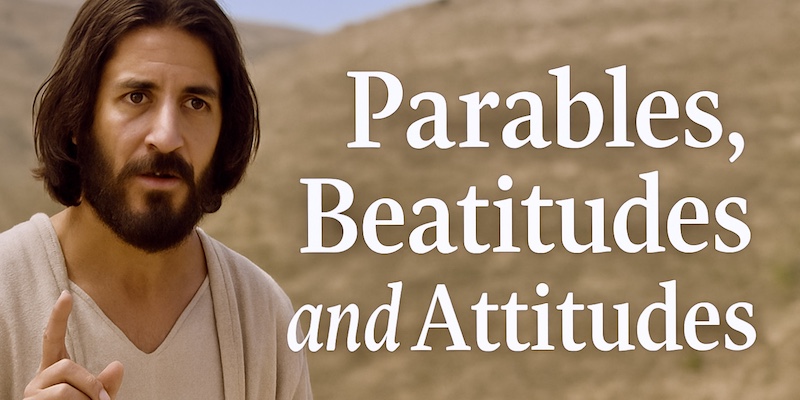
The Beatitudes & Attitudes
“Blessed are those that Mourn . . . “
Matthew 5:3-12
November 1, 2025
The Beatitudes & Attitudes. Matthew 5:3-12.
1. Blessed are the poor in spirit . . . Humility
2. Blessed are those that mourn . . . Repentance
3. Blessed are the meek . . . Gentleness
4. Blessed are those who hunger for righteousness . . . Obedience
5. Blessed are the merciful . . . Forgiveness
6. Blessed are the pure in heart . . . Integrity
7. Blessed are the peacemakers . . . Reconciliation
8. Blessed are those who are persecuted . . . Courage
1. Introduction – Overview
The word “Blessed” in the greek is “Makarios”, which means happy, fortunate and blissful. The term “makarios” is referred to in scripture as a happiness that comes from a deep inward contentment that ones life is right with God based on the new life he has created within us. It’s a happiness that comes from an inward attitude of gratitude not a condition predicated on assumed outward comforts.
The word “Poor” comes from the Greek word, “Ptochos”, which means not just poor, but begging poor. In Mark 12:41-44, we see the Widow was poor, but she still had two pennies that she could give at the temple. In Luke 16:19-31, Lazarus the beggar was so poor, he didn’t have even two pennies to his name. That is “Ptochos” poor.
Rabbi Jonathan Sacks: “Humility is not thinking less of yourself but thinking of yourself less. The truly humble man is free to serve.”
Isaiah 57:15, “For this is what the high and exalted One says—he who lives forever, whose name is holy: “I live in a high and holy place, but also with the one who is contrite and lowly in spirit, to revive the spirit of the lowly and to revive the heart of the contrite.”
“Those who come to the Lord with broken hearts do not leave with broken hearts . . . instead, in giving up their own kingdom, the poor in spirit inherit God’s.” John MacArthur page 151.
“Because of Christ we give off a sweet scent rising to God, which is recognized by those on the way of salvation – an aroma redolent with life.”
2 Corinthians 2:15
2. “Blessed are those that mourn, for they will be comforted.” Matthew 5:4
Psalm 55:6-8, “Oh, that I had wings like a dove! I would fly away and find rest. Behold, I would wander far and lodge in the wilderness. I would hasten to my place of refuge from the stormy wind and tempest.” King David
“Such a cry comes from the lips of almost everyone at some time or another. David echoes the cry of humanity – a cry for release, a cry for freedom, a cry for escape from things that weigh heavy on us . . . But comfort from the troubles of life is much harder to find than shelter from rain . . .
The paradox of the second beatitude is obvious. What could be more self-contradictory than the idea that the sad are happy, that the path to happiness is sadness, that the way to rejoining is in mourning? . . . The whole structure of most human living – is based on the seemingly incontrovertible principle that the way to happiness is having things go your own way . . . a basic axiom of the world has been that favorable things bring happiness, whereas unfavorable things bring unhappiness . . . Jesus turned the world’s principle upside down. He reversed the path to happiness.” John MacArthur commentary page 153-154.
“Happiness is not birthed out of the bounty of our success . . .
but out of the brokenness over our sin.”
D. Mike Collins
3. Types of Mourning.
Improper mourning comes from those who mourn over their sinful schemes. Case in point was David’s son Amnon who raped his sister Tamar. 2 Samuel 13:2. After he raped his sister, he was frustrated and mournful to the point he hated her. For such a situation, God offers no help to those who mourn.
Improper mourning comes from those who mourn too much. Case in point was David after the death of his son Absalom. 2 Samuel 18:33-19:4. David mourned so much over the death of his son, Joab rebuked him sharply. He told David, if he did not go out and console his troops, he would lose the entire army.
Proper mourning comes in the form of sorrow and grief over the death of loved ones and normal life situations. Sorrow provides a pathway for healing and restoration. Abraham was mournful at the death of his wife Sarah. Genesis 23:2. Defeat and discouragement caused Timothy to mourn. 2 Timothy 1:3-4. Jesus mourned at the death of his friend Lazarus. John 11:35.
When have you experienced various types of mourning? What did it feel like? How did you work through it? Are you still there? What helped you move on?
4. The Attitude of the “Mourning” Beatitude – Repentance
“The mourning about which Jesus is talking in the second beatitude however, has nothing to do with the types of mourning discussed, proper or improper . . . Jesus is speaking of godly sorrow, godly mourning that only those who sincerely desire to belong to Him or who already belong to Him can experience . . . Godly sorrow is linked to repentance, and repentance is linked to sin.” John MacArthur, pages 156-157.
“For the sorrow that is according to the will of God produces a repentance without regret, leading to salvation, but the sorrow of the world produces death. For behold what earnestness this very thing, this godly sorrow, has produced in you.” 2 Corinthians 7:10-11
“Of the nine terms used for sorrow, the one here “pentheo” is the strongest, the most severe. It represents the deepest, most heart-felt grief, and was generally reserved for the grieving over the death of a loved one . . . The word carries the idea of deep inner agony, which may or may not be expressed by outward weeping, wailing or lament . . .”
“Happiness, or blessedness, does not come in the mourning itself. Happiness comes with what God does in response to it, with the forgiveness that such mourning brings. Godly mourning brings Godly forgiveness, which brings Godly happiness . . . It is a communion with the living, loving God who responds to the mourning with an objective reality- the reality of divine forgiveness . . . Until sin is forgiven and removed, happiness is locked out. Mourning over sin brings forgiveness of sin, and forgiveness of sin brings a freedom and a joy that cannot be experienced in any other way.” John MacArthur, page 158.
“If we confess our sins, he is faithful and just to forgive us our sins and cleanse us from all unrighteousness.” 1 John 1:9
When was the last time you experienced inner “brokenness” over your sin?
“Draw near to God and He will draw near to you. Cleanse your hands, you sinners; and purity your hearts, you double-minded. Be miserable and mourn and weep; let your laughter be turned into mourning, and your joy to gloom. Humble yourselves in the presence of the Lord, and He will exalt you.” James 4:8-10.
“Come now says the Lord, though your sins are like scarlet, they shall be as white as snow, thought they are red as crimson, they shall be like wool.” Isaiah 1:18.
“Confess your sins to one another and pray for one another, that you may be healed.” James 5:16.
When was the last time you confessed your sin to another person? How might that lead to healing and restoration in ways that being quiet and reserve does not?
5. The Morning after “Mourning”.
“The result of godly mourning is comfort: they shall be comforted. That is why they are blessed. It is not the mourning that blesses, but the comfort God gives to those who mourn in a godly way . . . Comforted is from “parakaleo”, the same word that, as a noun, is rendered Comforter, or Helper, in John 14:16, where we are told that Jesus was the first Helper, and the Holy Spirit is “another Helper” . . . The Old Testament also speaks of God comforting those who mourn, “to comfort all who mourn, to grant those who mourn in Zion, giving them a garland instead of ashes, the oil of gladness instead of mourning” Isaiah 61:1-2 . . . Ours is the “God of all comfort” 2 Corinthians 1:3, who is always ready to meet our need, admonishing, sympathizing, encouraging, and strengthening. God is a God of comfort, Christ is a Christ of comfort, and the Holy Spirit is a Spirit of comfort. As believers we have the comfort of the entire Trinity!” John MacArthur, page 162.
“The Lord is my Shepherd, I shall not want. He makes me lie down in green pastures; he leads me beside still waters; he restores my soul. Yeah, though I walk through the Valley of the Shadow of Death, I will fear no evil, for you are with me. Your rod and staff, they comfort me.” Psalm 23:1-4
When have you experienced the deepest sense of God’s comfort in your life?
6. The Focus of The “Mourning” Beatitude.
Keep your eyes on the Cross.
“Let us fix our eyes on Jesus, the author and perfecter of our faith, who for the joy that was set before him endured the cross, scoring its shame, and sat down at the right had of the throne of God.” Hebrews 12:2
Guard your heart with the Word.
“How can a young man keep his way pure? By guarding it according to your Word . . . I have stored up your Word in my heart, that I might not sin against you.” Psalm 119:9,11
Fight forward in Prayer.
“Rejoice always, pray without ceasing, give thank in all circumstances, for this is the will of God in Christ Jesus for you.” 1 Thessalonians 5:16-18
“Weeping may last for a night, but joy comes in the morning.”
Psalm 30:5
“Blessed are those who mourn, for they shall be comforted.”
Matthew 5:4